
Understand the standards before you print your next workplace safety label
If you manage a facility, handle hazardous materials, or produce equipment that ships with warning labels, you have probably encountered both OSHA and ANSI standards. The two are related but not identical, and using the wrong format on a safety sticker can mean a failed inspection or, worse, a worker who misreads a warning. This guide breaks down OSHA vs ANSI safety labels and stickers so you know exactly what your labels need to say, how they need to look, and how to get them printed correctly.
How OSHA and ANSI Safety Label Standards Actually Work Together
OSHA does not publish a comprehensive label design specification the way ANSI does. Instead, OSHA regulations establish performance outcomes: workers must be warned of hazards, chemicals must be properly labeled, PPE must meet specified testing criteria. ANSI fills the design gap by providing detailed formatting rules that industry and regulators recognize as the authoritative benchmark.
The practical result is that ANSI Z535 is the most widely adopted standard for safety label design in the United States, even though OSHA does not mandate it by name in every regulation. ANSI Z535.4-compliant formatting is widely recognized as a best practice and may help demonstrate that hazards are being communicated clearly.
For chemical labeling specifically, OSHA's Hazard Communication Standard (29 CFR 1910.1200) aligns with the Globally Harmonized System (GHS) rather than ANSI Z535 directly. GHS labels use pictograms, signal words (Danger or Warning only), and specific hazard and precautionary statements. Equipment labels on machinery are more squarely within ANSI Z535.4 territory. Understanding which standard applies to your product or facility is the first step before ordering custom warning sticker requirements.
ANSI Z535 Label Components You Need to Know
ANSI Z535.4 provides standardized formats that typically include a signal word panel, a message panel, and, when appropriate, a safety symbol or pictogram. The signal word panel appears at the top and contains the appropriate word (DANGER, WARNING, CAUTION, or NOTICE) in a specific color. Below that is the message panel, which contains the hazard description and the consequences of ignoring it, plus recommended avoidance actions. Optionally, a safety symbol or pictogram can appear to the left of the signal word or within the message panel.
Color is not optional under Z535. ANSI Z535 specifies standardized color schemes for each signal word. Pantone values are commonly used by printers to achieve those colors consistently. These colors must have sufficient contrast with the text printed on them, and white or black text is prescribed for each combination. Substituting a close-enough orange or a bright yellow because it looks similar is a common error that creates compliance issues.
For anyone ordering custom ANSI warning labels, the file prep step is critical. Your artwork must use the correct Pantone or CMYK equivalents, keep text within the required panels, and use a highly legible typeface, typically sans-serif with adequate point size for legibility at the application distance. If you are printing die-cut stickers for equipment panels, confirm your label dimensions leave sufficient space to maintain legibility and preserve the standard label layout.
Choosing the Right Label Format for Your Application
The physical format of a safety label matters as much as its content. Flat rectangular labels are the most common format and work well for flat equipment surfaces. For curved or irregular surfaces, such as pipe sections, compressed gas cylinders, or vehicle components, a die-cut label on premium vinyl with air release technology prevents bubbling and peeling at the edges.
For indoor applications where labels are changed periodically — inspection tags, maintenance records, temporary hazard notices — crack-and-peel stickers on vinyl stock are a practical and cost-effective option. You can learn more about that format at the crack-and-peel stickers guide.
For outdoor equipment, vehicles, and heavy machinery, premium vinyl with UV and scratch-protective lamination is the appropriate material. The 8-year outdoor durability rating means labels applied to excavating equipment, utility vehicles, or marine machinery will remain legible through extended exposure. Labels that fade, peel, or crack are not just cosmetic problems — they create genuine safety risks if a worker can no longer read a DANGER or WARNING panel.
If you need multiple label variants for a single piece of equipment, a custom-cut sticker sheet lets you gang multiple label sizes and designs onto a single sheet, reducing per-unit cost and simplifying installation.
OSHA vs ANSI Safety Labels: Key Differences at a Glance
This table compares the two frameworks across the criteria that matter most when ordering custom workplace safety labels and stickers.
| Attribute | OSHA Standards | ANSI Z535 Standards |
|---|---|---|
Authority | U.S. federal regulatory agency (Department of Labor) | Private nonprofit consensus standards body |
Compliance status | Mandatory — federal law for covered employers | Voluntary — but widely adopted and referenced by OSHA |
Primary label regulation | HazCom/GHS (chemicals), 29 CFR 1910.145 (signs/tags) | ANSI Z535.4 (product safety labels), Z535.2 (facility signs) |
Signal words used | DANGER, CAUTION, WARNING (older 29 CFR 1910.145) | DANGER, WARNING, CAUTION, NOTICE (Z535.4) |
Color requirements | Specified by regulation but less granular | Standardized color schemes and formatting requirements for each signal word |
Symbol/pictogram rules | GHS pictograms for chemicals; limited guidance for equipment | Detailed criteria in ANSI Z535.3 for safety symbols |
Where it applies | U.S. workplaces covered by OSHA jurisdiction | Broadly applicable; used internationally as a best-practice benchmark |
Label material requirements | Legible, durable for conditions of use | No material specification; durability is designer/buyer responsibility |
Enforcement | OSHA inspections, citations, fines | No direct enforcement; compliance demonstrated through inspection outcomes |
Common Questions About OSHA and ANSI Safety Labels
- What is the difference between OSHA and ANSI standards?
- OSHA (Occupational Safety and Health Administration) is a federal regulatory agency. Its standards are laws. Employers must comply or face fines and penalties. ANSI (American National Standards Institute) is a private nonprofit that publishes voluntary consensus standards. ANSI Z535 is the widely adopted standard for safety signs and labels, covering color, format, signal words, and symbol use. OSHA often references or incorporates ANSI standards by citation, which is how a voluntary standard can effectively become a legal requirement in specific regulated contexts.
- What is the ANSI standard for safety labels?
- ANSI Z535 is the primary standard governing safety labels. It is broken into several parts: Z535.1 covers safety colors, Z535.2 covers environmental and facility safety signs, Z535.3 covers criteria for safety symbols, Z535.4 covers product safety signs and labels, and Z535.5 covers safety tags. It defines the required signal words (DANGER, WARNING, CAUTION, NOTICE), the color codes tied to each, and the layout panels that must appear on a compliant label.
- Is ANSI Z87 required by OSHA?
- Yes, in practice. OSHA's eye and face protection standard (29 CFR 1910.133) requires protective eyewear to comply with ANSI/ISEA Z87.1 or provide equivalent protection. Equipment that carries the Z87 marking has been tested to that standard. The Z87 sticker or stamp on safety glasses is not decorative — it confirms compliance. If you manufacture or import PPE that requires Z87 marking, the mark must appear on the product itself, not just the packaging.
- What signal words are required on ANSI Z535-compliant labels?
- ANSI Z535.4 defines four signal words. DANGER (red header panel) indicates an imminently hazardous situation that will result in death or serious injury. WARNING (orange header panel) indicates a potentially hazardous situation that could result in death or serious injury. CAUTION (yellow header panel) indicates a potentially hazardous situation that may result in minor or moderate injury. NOTICE (blue header panel) is used for non-injury-related information. ANSI Z535 establishes standardized color schemes for each signal word, and compliant labels should use the prescribed colors and formatting associated with that signal word.
- Can I order custom ANSI-formatted safety stickers with my own artwork?
- Yes. Stickers.com prints fully custom safety labels and stickers from customer-supplied artwork. You supply a file that matches the required ANSI Z535 layout, signal word, and color specifications, and we print it on durable vinyl with UV-protective lamination. Standard vinyl is rated for 3-5 years of outdoor durability, and premium vinyl extends that to up to 8 years, making it suitable for outdoor equipment, vehicles, and machinery exposed to the elements.
- What material should I use for workplace safety labels that need to last outdoors?
- For indoor equipment labels in controlled environments, economy vinyl with UV lamination holds up well and keeps costs low. For outdoor equipment, vehicles, or machinery exposed to moisture, temperature swings, or direct sun, standard vinyl or premium vinyl is the right choice. Standard vinyl carries a 3-5 year outdoor durability rating with UV, scratch, and moisture-protective lamination. Premium vinyl extends that to up to 8 years and includes air release technology for application to contoured surfaces. Die-cut stickers are a practical format for safety labels that need to fit specific panel spaces on equipment.
Custom Safety Labels and Stickers for OSHA and ANSI Compliance
Every product below is printed to order from your artwork and shipped directly to you. Choose the material and finish that matches your application environment, from indoor equipment panels to heavy outdoor machinery.
 Safety Labels and Warning Stickers
Die-Cut Stickers
Stickers cut around your designs
Shop on Stickers.com Safety Labels and Warning Stickers
Circle Stickers
Stickers with a rounded design
Shop on Stickers.com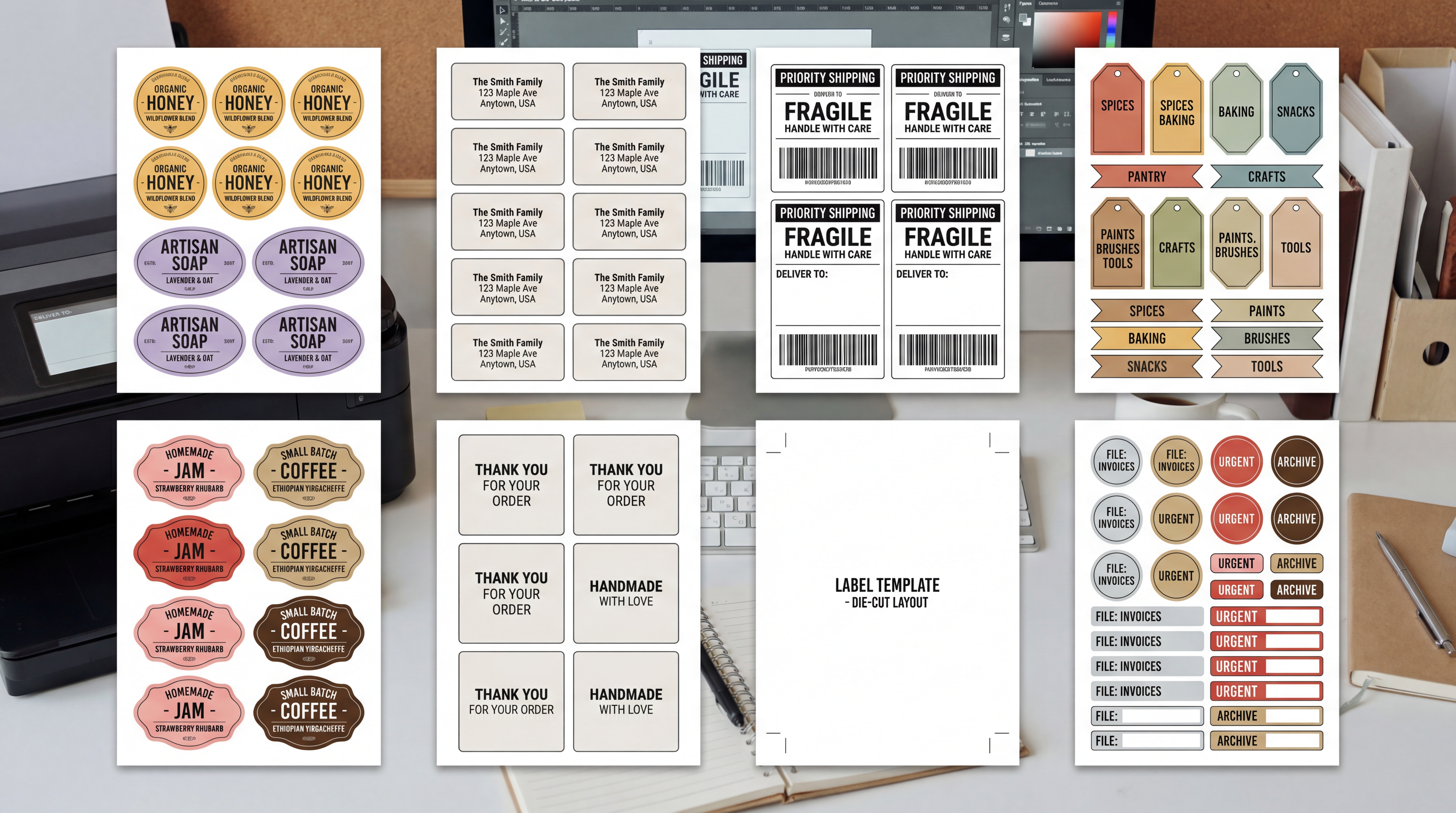 Safety Labels and Warning Stickers
Custom Label Sheets
Your labels in sheet format
Shop on Stickers.comReady to Print Your Custom Safety Stickers?
Upload your ANSI Z535 or OSHA-formatted artwork and get a custom quote in minutes. Orders start at 1 unit with no minimum quantity requirement, and bulk pricing kicks in at 50 units or more. Standard production is 3 business days, with rush options available when you need labels fast. All vinyl products include UV-protective lamination to keep signal word colors accurate over the life of the label.