Food Product Label Requirements: What Must Be Included on Food Packaging?

Food Product Label Requirements: What Must Be Included on Food Packaging?

Custom food product labels and stickers printed to your specs, compliant-ready, and shipped fast.

Selling food products means navigating a specific set of labeling rules. Whether you make artisan jam, bottled hot sauce, packaged baked goods, or a line of health supplements, your labels need to communicate the right information in the right format. This guide breaks down FDA food labeling requirements, explains what belongs on your packaging, and shows you how to order custom food product labels and stickers that are production-ready in as little as one to three business days.

Understanding FDA Food Labeling Requirements

The FDA regulates food labeling under the Federal Food, Drug, and Cosmetic Act and the Fair Packaging and Labeling Act. Most packaged food products sold commercially in the U.S. must comply with these rules, regardless of whether they are produced by a national manufacturer or a small cottage food operation.
The six core elements required on nearly every food package are:
1. Statement of Identity: The common or usual name of the product, displayed prominently on the principal display panel. This tells the consumer exactly what they are buying.
2. Net Quantity of Contents: The amount of product inside the package, expressed in both metric and U.S. customary units. This appears on the principal display panel near the bottom.
3. Name and Address of Manufacturer, Packer, or Distributor: If you are selling under your own brand, your business name and address are required. If you use a co-packer, a 'manufactured for' statement with your brand's address is acceptable.
4. Ingredient List: All ingredients listed in descending order by weight, using standardized names. This appears on the information panel (typically the side or back label).
5. Nutrition Facts Panel: Required for most packaged foods regulated by the FDA. The updated Nutrition Facts label format introduced in 2020 requires a larger calorie count display, added sugars, and updated daily value percentages.
6. Allergen Declarations: Under the Food Allergen Labeling and Consumer Protection Act (FALCPA) and the FASTER Act, major allergens including milk, eggs, fish, shellfish, tree nuts, peanuts, wheat, soybeans, and sesame must be declared clearly. This is typically done with a 'Contains:' statement following the ingredient list.
Some categories have additional requirements. Juice products must display a percent juice content statement. Dietary supplements follow a different panel format with a Supplement Facts box instead of Nutrition Facts. Organic claims require USDA certification. Country of origin labeling rules apply to certain commodities.
For small businesses, there are limited exemptions to the Nutrition Facts requirement. A company with fewer than 100 full-time employees that sells fewer than 100,000 units of a given product annually may qualify for a small business exemption. These businesses should still include all other mandatory elements and should confirm their exemption eligibility with the FDA directly.
This guide covers the most common federal requirements. State-level regulations, particularly around cottage food laws, vary significantly. If you are selling in California, New York, Texas, or another state with active cottage food programs, check your state's department of agriculture for any additional requirements beyond federal rules.

What Goes on Each Panel of a Food Package

Food packaging is divided into defined zones, and knowing what belongs where helps you design labels that are both compliant and visually effective.
The Principal Display Panel (PDP) is the face of the package, the surface most likely to be seen by a consumer on a shelf. It must display the product's statement of identity and the net quantity statement. Beyond those required elements, the PDP is your primary branding real estate: your logo, photography, flavor descriptor, and visual hierarchy all live here.
The Information Panel is the surface immediately to the right of the PDP when the package is facing the consumer. This is where the Nutrition Facts panel, ingredient list, allergen declaration, and manufacturer information belong. The FDA requires these elements to appear together on the information panel without intervening material.
If your packaging is cylindrical (a jar or bottle), labels wrap around the container and the PDP and information panel are sections of that wrap. If you are applying separate front and back labels, the back label functions as the information panel.
For very small packages (less than 12 square inches of total display area), some labeling elements can be condensed or formatted differently. The FDA publishes specific guidance for small and intermediate-sized packages that is worth reviewing if you are working with 2-ounce bottles, single-serve pouches, or compact tins.
Designing your label with this panel structure in mind from the start prevents the common problem of finishing a beautiful design only to realize the information panel does not have enough room for a properly formatted Nutrition Facts box. A good rule of thumb: sketch out where each required element will live before you finalize artwork.
For more on building out your packaging system holistically, the product packaging guide on our blog covers material choices, label placement, and design tips for consumer product brands.

Nutrition Label Requirements: Format, Type Size, and Layout Rules

The Nutrition Facts panel has more specific formatting requirements than any other element on a food label. The FDA prescribes the format, type sizes, line weights, and the order in which nutrients are listed.

The standard vertical format is the default. The panel must list calories, total fat, saturated fat, trans fat, cholesterol, sodium, total carbohydrate, dietary fiber, total sugars, added sugars, protein, and then a set of vitamins and minerals. Vitamin D, calcium, iron, and potassium are required; additional vitamins and minerals are optional unless they are added to the food or a claim is made about them.

Type size rules specify that 'Nutrition Facts' must appear in a specific bold format. Calories must appear in a larger type (typically 22-point or larger for standard panels). Serving size and servings per container are also prominently sized. Most other elements use 8-point type minimum, with some line items permitted at 6-point.

If your package does not have enough room for the standard vertical format, the FDA allows a tabular format (horizontal layout) or a linear format for very small packages. The simplified format is available when certain nutrients are present in insignificant amounts.

When you provide artwork for your food product labels and stickers, make sure the Nutrition Facts panel is submitted as a finalized, correctly formatted graphic rather than editable text. Many food producers use a Nutrition Facts generator, then embed the resulting image into their label design file before uploading for print.

A few common mistakes to avoid: using gray backgrounds behind the panel (the FDA requires black and white for most formats, with limited exceptions), using type that falls below the minimum size, and listing ingredients in alphabetical order rather than by weight. These errors are caught during FDA inspections and can result in warning letters.

Choosing the Right Food Product Label Material and Finish

Once you know what your label must say, the next step is choosing a format and material that will hold up through production, shipping, storage, and use.
Vinyl labels are the standard choice for most food applications. Waterproof vinyl with lamination resists moisture, oil, and condensation, making it suitable for refrigerated products, cooking oils, sauces, and beverages. Standard vinyl offers a lifespan of up to three to five years with proper care, which is more than enough for products that will be consumed well before that.
Paper roll labels are a lower-cost option for dry goods and bakery products where moisture is not a concern. White gloss paper gives a bright, clean look that works well for colorful label designs. White matte paper provides a softer, more artisan aesthetic that is popular with craft food producers.
Finish choice affects both aesthetics and function. Gloss finish creates a vibrant, reflective look that makes colors pop on shelf. Matte finish reduces glare and gives products a premium, understated appearance. Both finishes provide UV and scratch protection through the laminate layer.
For product packaging that needs to stand out with a premium look, clear labels are worth considering. A clear label on a glass jar or bottle creates a no-label look where only the printed elements are visible, which works especially well for high-clarity products like honey, olive oil, and infused vinegars.
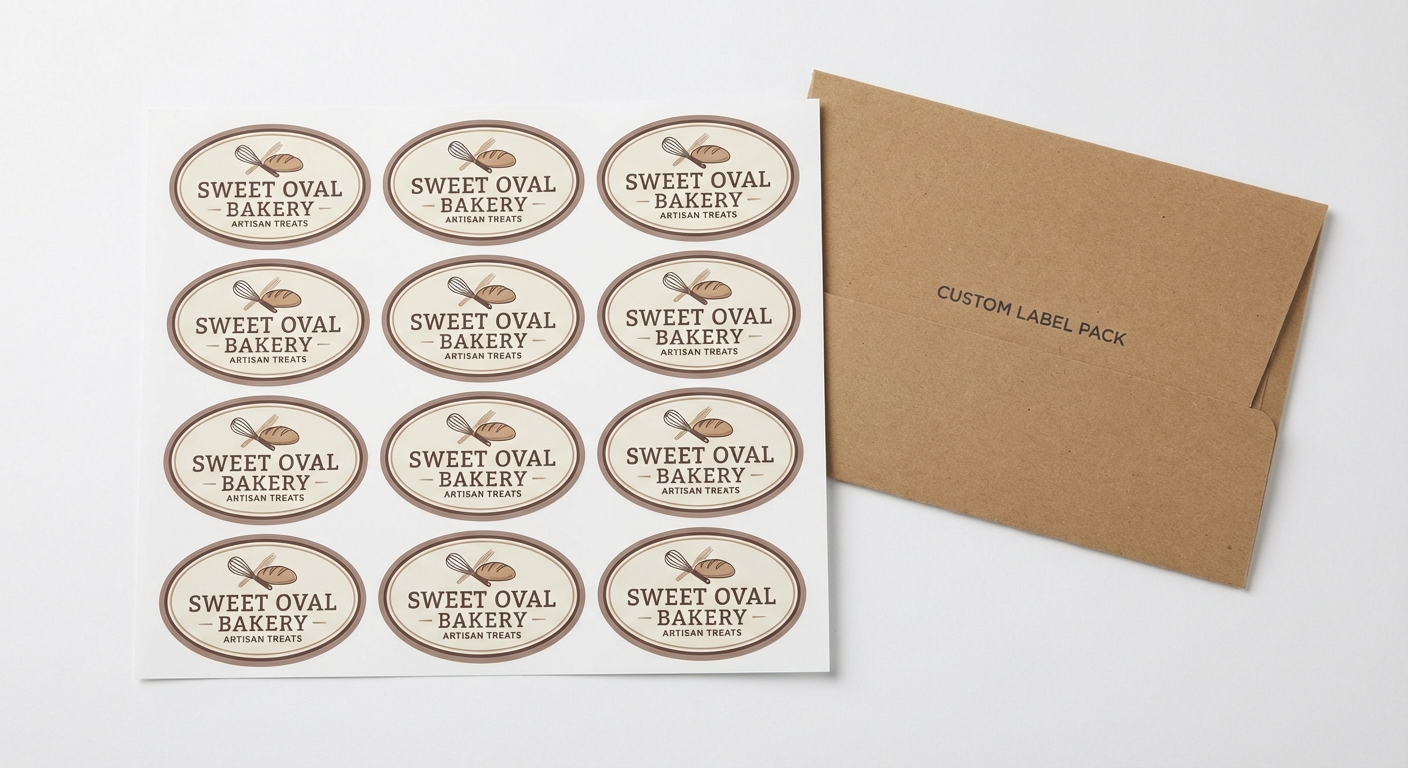
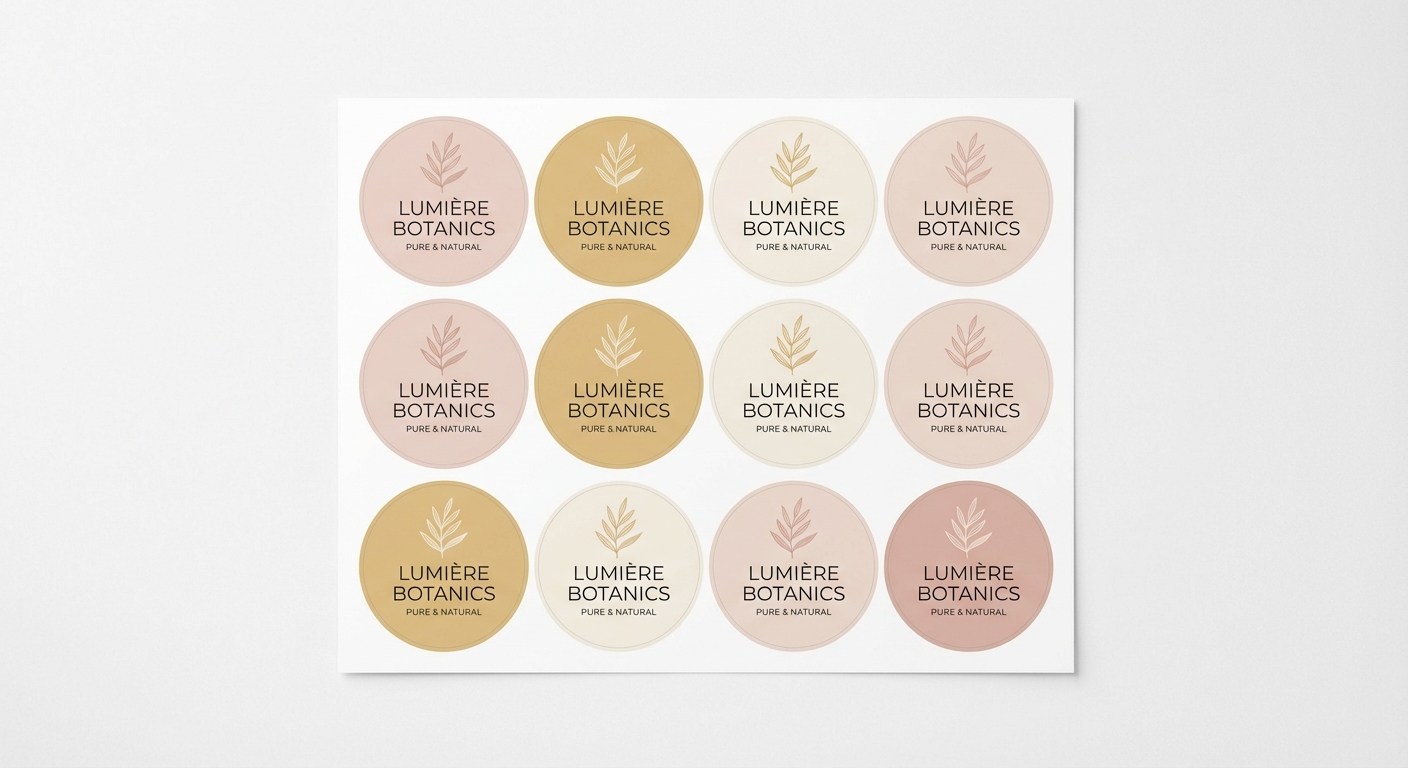
Label shape also affects perception. Circle and oval labels have a classic, artisanal quality that reads well on jars and bottles. Rectangle labels maximize information density and are practical for packages that carry a lot of required text. Die-cut custom shapes create a distinctive shelf presence but require a bit more lead time in the design phase.
For brands selling multiple SKUs (flavors, sizes, varieties), label sheets offer a flexible way to print small quantities of each variant without committing to a large roll order for every SKU. This is especially useful for seasonal items or limited releases.

Food Label Format Comparison: Sheets vs. Roll Labels

The two primary formats for food product labels are label sheets and roll labels. Each has distinct advantages depending on your order volume, application method, and production setup.
FeatureLabel SheetsRoll Labels (Paper)Roll Labels (Waterproof Vinyl)
Minimum Order
5 sheets
500 units
500 units
Best For
Low volume, sampling, testing designs
Dry goods, bakery, ambient storage
Refrigerated, bottled, or wet-environment products
Application Method
Hand-applied from sheet
Hand or machine application
Finish Options
Gloss or Matte
Gloss or Matte
Gloss or Matte
Material
Standard Vinyl
White paper
Clear Vinyl
Moisture Resistance
Good (vinyl with lamination)
Low
High
Shape Options
Circle, Oval, Rectangle, Square, Rounded Corner, Custom
Circle, Oval, Rectangle, Square
Ideal Volume
5 to a few hundred
500 to 5,000+
 500 to 5,000+

Common Questions About Food Product Labels and Stickers

What information is legally required on a food product label?
Under FDA food labeling requirements, most packaged food products sold in the United States must include: the statement of identity (product name), the net quantity of contents, the name and address of the manufacturer or distributor, an ingredient list in descending order by weight, a Nutrition Facts panel (required for most packaged foods), and any allergen declarations required under FALCPA. Some small businesses qualify for exemptions from the Nutrition Facts requirement, but the other elements remain mandatory. Always verify your specific obligations with an FDA compliance resource or food regulatory attorney before going to market.
Can I use a custom-printed sticker as a food label?
Yes. A custom-printed adhesive label or sticker applied to your packaging functions the same way as a pre-printed label, provided it contains all legally required information and adheres durably to the container. The FDA does not distinguish between a printed container and an applied label. Many small-batch food producers use custom label sheets or roll labels applied to jars, bottles, bags, and boxes. The critical factors are legibility, durability, and completeness of the required content.
What material should I use for food product labels?
The right material depends on your storage and handling conditions. For refrigerated or frozen products, waterproof vinyl roll labels hold up against condensation and cold surfaces. For dry goods stored at room temperature, paper labels work well and give a more natural aesthetic. For products that will be washed, submerged, or exposed to moisture, waterproof vinyl with gloss or matte lamination provides the best durability. Stickers.com offers both vinyl and paper so you can match the material to your packaging environment.
How small can the text on a food label legally be?
FDA regulations specify minimum type sizes for different label elements. For principal display panels, the statement of identity must be prominent and conspicuous. The net quantity statement on packages with less than 5 square inches of display space must be at least 1/16 inch in height. The Nutrition Facts panel has its own type size rules, typically requiring no less than 6-point type for most elements and 8-point for the serving size and calorie count on standard panels. When designing your custom food label, build in enough space to meet these minimums clearly. If your label is small, a vertical Nutrition Facts format or a tabular format may be permitted.
How many food labels should I order at once?
Label roll orders at Stickers.com start at 500 units, which suits small-batch producers testing a new product line. For established brands moving steady volume, orders of 1,000 to 5,000+ units reduce the per-unit cost significantly. Label sheets have a minimum order of just 1 sheet, making them ideal for prototyping, farmers market runs, or low-volume cottage food operations. If you are unsure of your volume, starting with sheets to validate your design before committing to a roll order is a practical approach.
How fast can I get food labels printed and shipped?
Production time at Stickers.com is 3 business days for most label products, depending on the option you select at checkout. Rush production (2 business days) is available on select products. After production, FedEx or UPS handles delivery, so factor in transit time based on your location. For time-sensitive launches or restock situations, ordering with the fastest production tier and choosing an expedited shipping method at checkout is the most reliable path.
Custom Food Product Labels and Stickers

Every label below is custom-printed with your artwork and shipped directly to you. No minimums on sheet formats. Roll labels start at 500 units with tiered pricing for larger quantities.
Rectangle Label Sheets Labels

Rectangle Label Sheets

Starting at $1

Shop on Stickers.com
Circle Label Sheets Labels

Circle Label Sheets

Circular Labels in Sheet Format

Shop on Stickers.com
Circle Waterproof Roll Labels Labels

Circle Waterproof Roll Labels

Starting from 500 units

Shop on Stickers.com
Oval Label Sheets Labels

Oval Label Sheets

Labels with an oval shape

Shop on Stickers.com

Ready to Print Your Food Product Labels?

Order custom food product labels and stickers with no hidden fees, fast production, and free shipping on qualifying orders. Upload your artwork, choose your material and finish, and get labels that are ready to apply to your packaging.
Create Your Food Product Labels